Before you go

Read the first chapter — for free.

Receive Chapter 1 as a PDF to your email. No commitment — and no spam.

✦ The book nobody gave you in school

How long have you been putting off the day your money starts working for you?

For most people, the problem isn't the salary. Nobody ever taught them how to manage money — and every year that passes without that knowledge costs more than it seems.

“A direct, honest and practical guide. From zero to your first investment — no complicated terms, no impossible promises.”
I want to start now Available on Amazon — automatically redirects to your country.
No conflicts of interest Simple and direct language PT + EN
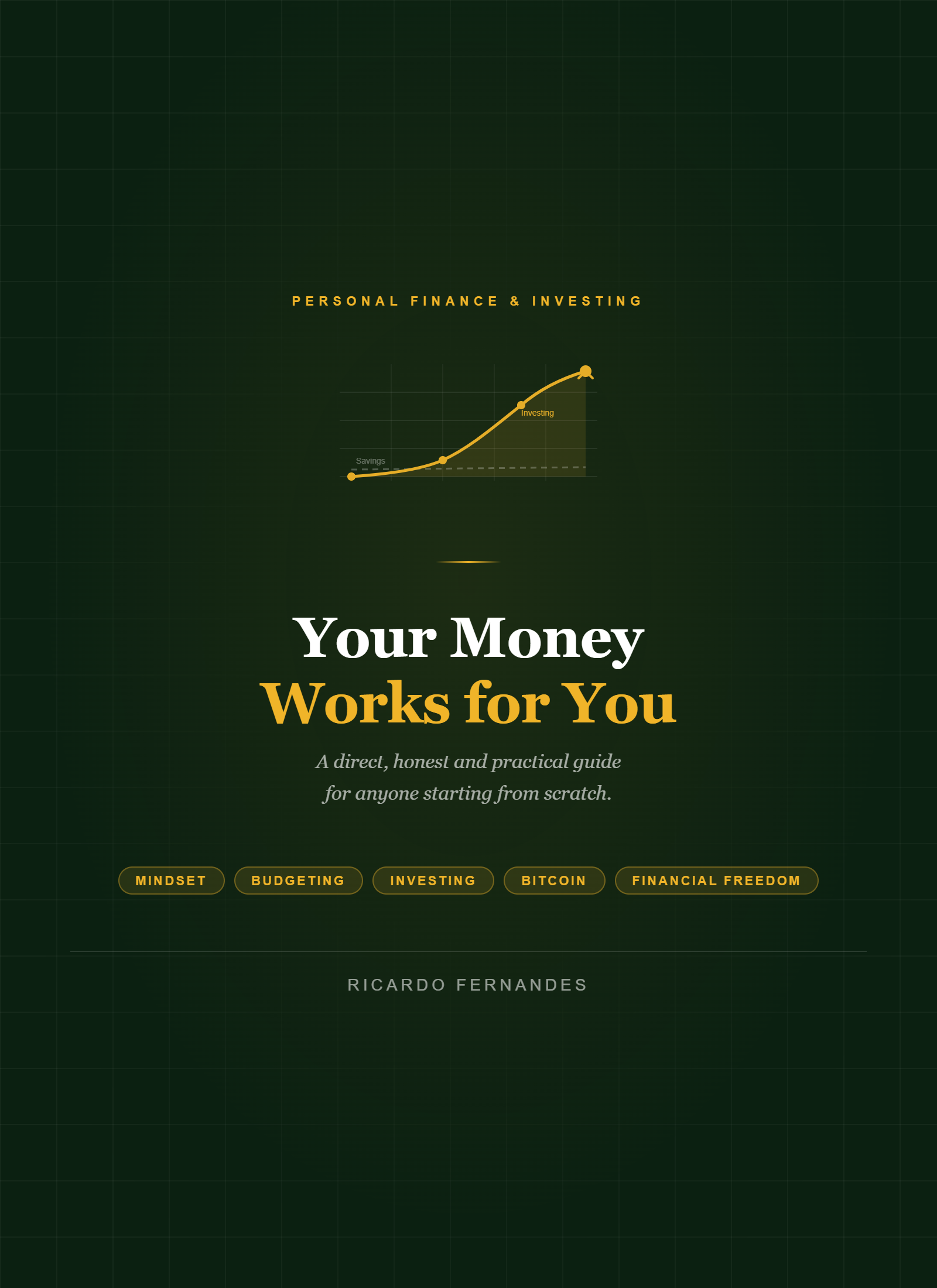
Cover of the book Your Money Works for You
Available now

Do you recognize yourself in this?

You're not alone. These situations affect most people — and the worst part is they tend to last for years without anything changing.

You reach the end of the month without knowing where the money went — for the hundredth time.
You tell yourself “when I earn more, I'll start saving” — and you keep waiting.
You have debts that never seem to shrink, no matter how hard you try.
You hear about ETFs, portfolios and passive income — and you don't know where to begin.

And the worst part isn't where you are today. It's that, if nothing changes, you'll be in the same place 5 years from now.

Be honest with yourself

This book is not for everyone

Not for you if...

You're looking for a formula to get rich quickly — without effort and without time.
You already have solid investment experience and are looking for advanced strategies.
You believe your financial problems can only be solved by earning a much higher salary.
You're not willing to change any financial habits.

For you if...

You finally want to understand where your money goes every month.
You're ready to take the first steps — even small ones — toward financial stability.
You want a solid foundation: budgeting, debt, savings and investing — in that order.
You prefer honesty over promises — and action over theory.
What's holding you back

The belief that's costing you the most money

I'll invest when I earn more.
The reality:

When you earn more, you'll spend more. The pattern doesn't change on its own — it changes with a system. And that system works on any salary.

Investing is too risky for me.
The reality:

Not investing is also a risk. Inflation quietly destroys the purchasing power of money sitting in your account — every single year.

I'm terrible with money, that won't change.
The reality:

Nobody is born knowing how to manage money. It's a skill — it can be learned. What's almost always missing isn't the will to save. It's structure.

Free sample — Part I

Chapter 1 — Why most people never build wealth

There is a question almost nobody asks out loud, but that many people think in silence: "I work so hard. Why do I never have any money?"

If you have had that thought, you are not alone. And, more importantly, it is not entirely your fault. The truth is that nobody taught us. Not at school, not at home, not anywhere in any systematic way. We learned to read, to write, to calculate the area of a triangle — but nobody explained how a salary works, what to do with it after you receive it, or why keeping money under the mattress is, literally, a terrible financial idea.

We grew up watching the adults around us work hard, spend what they earned, and wait for the next month. And without realising it, we internalised that model. Not because it is correct. Simply because it was the only one we ever saw.

The cycle that traps most people

Imagine a wheel. You enter the job market, receive your first pay cheque and the feeling is good — there is money in the account, you are independent, you are an adult. You pay the bills, buy what you need, buy what you do not need, because you deserve it, you earned it. At the end of the month, little or nothing is left. Next month, it all repeats.

Economists call this lifestyle inflation: as you earn more, you spend more. Your standard of living rises in parallel with your income, and the gap between what you earn and what you save stays exactly the same — small, or nonexistent.

"It is not a question of earning too little. Some people earn high salaries and live in debt. Others with modest incomes build solid wealth over the years. The difference is not in how much they earn. It is in what they do with what they earn."

The financial education we never had

It is not just a lack of discipline. It is also a lack of information. We were sent out into the world without the basic instruction manual. And the system — banks, retailers, easy credit platforms — benefits when we do not know. It benefits when we buy impulsively, when we accept the first loan offered to us, when we leave money in an account earning nothing.

That is not an accident. It is, in part, by design. Financial services companies invest enormous sums in making their products confusing, in making the small print even smaller, in presenting rates in ways that disguise the real cost. The result, for anyone without basic financial literacy, can be devastating.

What separates those who build wealth from those who do not

Once you understand the problem, the good news: it is not luck, it is not fate, it is not about being born into the right family. It is, above all, a set of habits and decisions repeated over time. And habits can be learned.

People who build wealth — consistently, over years — tend to do three things that most people do not do deliberately:

First, they spend less than they earn. It sounds obvious. It is. But the vast majority of people do not do this consistently. Those who build wealth treat saving as a mandatory expense — not as whatever happens to be left at the end of the month. They pay themselves first.

Second, they put their money to work. Money sitting in a current account loses purchasing power every year due to inflation. Those who build wealth put their money into assets that grow — not to get rich overnight, but so that time and compound interest do the heavy lifting.

Third, they have a plan. Not complicated. Simply a clear idea of where they are going and why. A goal. A direction.

"But I don't earn enough to invest"

This is probably the most common objection. And it is understandable — when your salary barely makes it to the end of the month, talking about investing feels like a luxury for other people.

But here is what is rarely said: starting with little is better than not starting. Much better. Not because €20 a month will make you rich. But because the habit you create is more valuable than the amount itself. The financial muscle, like any muscle, grows with training. Someone who starts investing €20 a month tends, over time, to invest €50, then €100, then more. Someone who waits until they "have enough money" to start often never starts at all — because that moment rarely arrives on its own.

"The best time to plant a tree was twenty years ago. The second best time is now."
— Chinese proverb, which applies surprisingly well to investing.

Beyond that — and this point is crucial — time is your greatest financial ally. A euro invested today is worth far more than a euro invested ten years from now. Not by magic. By mathematics. We will explore this in detail later.

Sarah, a 27-year-old teacher, recognised this pattern the first time she ran the numbers. She had just received her March pay cheque and, without quite understanding how, reached the 20th of the month with nothing left. There had been no expensive holidays, no extraordinary purchases. It was the accumulation of a thousand small unthought decisions: Monday night takeaway, forgotten subscriptions, last-minute gifts. "It's not that I overspend," she said. "It's that I never know where it goes." It was the first time she had framed the problem precisely. And framing a problem well is already half the solution.
Continue reading on Amazon → The full chapter and the rest of the book are available on Amazon.
Your journey

From financial chaos to complete clarity

This isn't a book to read and forget. It's a guide you follow at your own pace — with concrete steps in every part.

Part 1

Mindset

Identify the beliefs that are holding you back — and understand where they come from. Without changing how you think about money, no technique works long-term.

→ Outcome: clarity on what's been holding you back
Part 2

Budget

Create a simple system where you always know where every euro goes. It's not about cutting everything — it's about consciously deciding what you value.

→ Outcome: full control of your monthly finances
Part 3

Debt

Learn the most effective strategy to pay off debts — and understand why most people can never get out of them without a specific plan.

→ Outcome: a real plan to become debt-free
Part 4

Savings

Build a financial cushion that gives you real peace of mind. And learn to automate savings — so it happens without you having to remember.

→ Outcome: financial security, even with unexpected expenses
Part 5

Investing

Take your first steps with confidence. No complex products, no get-rich-quick promises — just what works, explained simply.

→ Outcome: your first investments, working for you
What's inside

Full contents

Part I
The Right Mindset
~35 pages
Why most people never build wealth · The emotional relationship with money · The 3 habits that change everything · How to set real goals
Part II
Organise Your Finances
~50 pages
Budgeting without suffering · Eliminating debt · The emergency fund · Essential insurance · Money as a couple
Part III
Start Investing
~55 pages
Compound interest · Savings products · The stock market · ETFs and index funds · Real estate
Part IV
Bitcoin and Cryptocurrencies
~35 pages
Blockchain · Bitcoin vs. altcoins · How to buy safely · Real risks · How much to allocate · Common mistakes · Taxes
Part V
Strategies and Life Plan
~30 pages
Building a portfolio · Tax efficiency · Financial independence — the plan

Thoughts you may have already had...

They're valid. Many people who got where they wanted started with exactly these thoughts.

“I don't earn enough, it won't work.”
It makes sense to think that. Many people who say the same discover, when they look closely at their expenses, that there's more room than they thought. The book helps you see that — without judgment.
“I've tried saving before and it never worked.”
What if the problem wasn't you? Everyone has the will to save. What's almost always missing is a system that works even in the hard months — not willpower, but structure.
“Investing? That's for people with a lot of money.”
That idea makes total sense — and it's wrong. The world's greatest investors recommend exactly the opposite: start early, with little, consistently. Time is the only ingredient you can't buy later.
RF

Ricardo Fernandes

I am not an economist or a financial manager. I am someone who learned the hard way — by making mistakes — and then spent years studying what really works. That perspective is, perhaps, this book's greatest advantage: it was written by someone who was exactly where you are now.

I went from having no savings and credit card debt to having 12 months of emergency fund and investing automatically every month. It took 4 years. It wasn't quick. It wasn't easy. But it was possible — with simple principles that anyone can apply, regardless of their salary.

Reviews

What readers say

4.2
★★★★ out of 5 stars · 31 reviews
★★★★★
I've spent years buying finance books and not finishing them. This one I read in two sittings. The writing doesn't talk down to you, doesn't assume you have a finance degree, and actually gets to the point. Set up my first ISA the same week.
Oliver
31 · Software Developer · London, UK
Verified Purchase
★★★★★
Most personal finance books feel written exclusively for Americans. This one actually makes sense for someone living in Europe — the tax logic, the investment products, the examples. The ETF chapter is the clearest I've found anywhere. I've already bought a copy for my sister.
Sophie
34 · HR Manager · Dublin, Ireland
Verified Purchase
★★★★
I had credit card debt I'd been carrying for two years and no idea where to start. The debt chapter gave me a clear, logical plan. Seven months later it was gone. What I appreciated most is that it never makes you feel stupid for not knowing this already.
Lars
38 · Engineer · Amsterdam, Netherlands
Verified Purchase
★★★★
The compound interest chapter reframed something I thought I understood. Seeing the actual numbers projected over 20 and 30 years changed how I think about every purchase. Started my index fund contributions the week I finished reading.
Marie-Claire
41 · Nurse · Lyon, France
Verified Purchase
★★★★
Honest, direct, no ideology. I recommended it to everyone in my team — we're all in our 30s and none of us were taught any of this at school or university. The behavioural finance section explains why smart people keep making the same financial mistakes.
Markus
33 · Product Manager · Berlin, Germany
Verified Purchase
★★★
Good foundations, well written. The Bitcoin chapter is more balanced than most — doesn't hype it, doesn't dismiss it. For someone already familiar with the basics, some early sections are revision. But the life plan and financial independence chapters are genuinely strong.
Anna
27 · Graphic Designer · Stockholm, Sweden
Verified Purchase

Read the first chapter. For free.

Receive Chapter 1 as a PDF — “Why most people never build wealth” — directly to your email. No commitment.

Available on Amazon

Choose your format

A financial adviser charges €150/hour. A typical online course costs €300+. This book costs €3.99.
Ebook · Kindle
Read on any device, in seconds.

Available immediately after purchase. Compatible with the free Kindle app for phone, tablet or computer.

3.99
Launch price
on Amazon
Buy Ebook → Not happy? Amazon will refund you.

Learn before you decide

Free articles on personal finance, investing and money management.

See all articles →
Frequently asked questions

Have questions? That's normal.

The most common questions — answered directly.

No. The book was written specifically for anyone starting from zero — no economics background, no prior investment experience. If you already have some knowledge, you can go directly to the most relevant chapter for your situation.
It was written with the European context in mind — tax, cultural and market. It does not rely on American assumptions that don't apply to those living in Portugal or Europe.
Yes — and the book addresses this directly. Starting today is always better than not starting. There is a character in the book, Martha (52), specifically created for anyone in this situation who wants to understand what is still possible.
Yes. Part IV is dedicated to Bitcoin and cryptocurrencies — no hype, no promises, with the real risks explained honestly, including how to buy safely and how much it makes sense to allocate.
The book is available on Amazon. The buy button on this site automatically detects your country and redirects to the correct Amazon — amazon.co.uk for the UK, amazon.com for the US, amazon.de for Germany, etc.
The decision is yours

12 months from now, which version of yourself do you want to be?

Without the book Still reaching the end of the month not knowing where the money went. Postponing. Waiting for a raise.
With the book With a budget that works, a financial cushion built, and the first investments already growing.
I want to be that second version → Available on Amazon — automatically redirects to your country. Not happy? Amazon will refund you.
Share with someone who needs to read this